Full Exterior Stucco Repaint, The Boltons
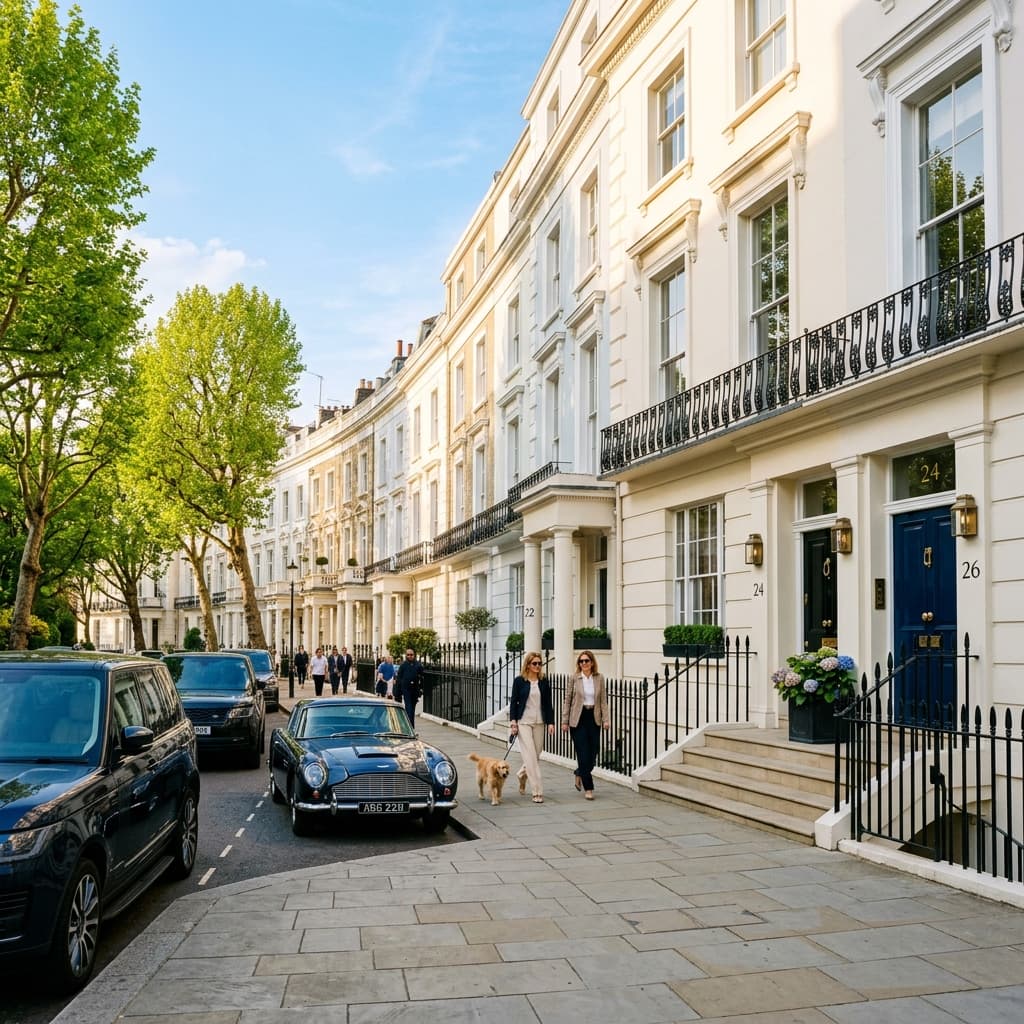
The Boltons is one of London's most prestigious addresses, and this detached Italianate villa — one of the original pairs designed by George Godwin in the 1850s — is among its finest properties. The owner commissioned a full exterior repaint after noticing progressive paint failure on the south-facing elevation, where large areas of the previous masonry coating had begun flaking away from the stucco in sheets, exposing the render beneath to the weather. The property's four rendered facades, elaborate moulded window surrounds, first-floor balustrades with turned balusters, a deep projecting cornice at roof level, and the pilastered entrance porch with its Corinthian capitals presented a substantial and architecturally complex surface area requiring careful, methodical preparation and a breathable paint system that would perform for a minimum of eight to ten years in this exposed, garden-facing setting. Given the property's position within the Boltons Conservation Area, all colour choices required prior approval from RBKC's conservation and planning department, a process that typically takes four to six weeks. We managed the entire process from start to finish — initial colour consultation and sample preparation, submission of the conservation area consent application, coordination with neighbours regarding scaffolding and access, specification of appropriate materials, and execution of the painting programme through to final completion and scaffold strike — providing the owner with a single point of contact throughout. The total external surface area exceeded 450 square metres, making this one of our largest single-property exterior projects in Chelsea.
The Challenge
The south and west elevations had experienced significant paint failure, with large areas of flaking and delamination caused by moisture trapped beneath a non-breathable acrylic masonry paint applied by a previous contractor approximately twelve years earlier. The trapped moisture had not only caused paint failure but had begun to damage the stucco itself, with frost action creating spalling and surface erosion in several areas. Simply overcoating this failed system was not viable — the existing paint needed to be completely removed back to stable, sound render before any new system could be applied. The property's ornate architectural details — deep window reveals with moulded architrave surrounds, Corinthian pilasters flanking the entrance porch, turned balusters along the first-floor balcony, a continuous dentil cornice at roof level, and a heavily moulded entrance surround with projecting hood — made mechanical preparation extremely difficult without risking damage to the render profiles. These ornamental features contained undercuts, deep recesses, and fragile projecting edges that could not withstand aggressive scraping or power-washing. Scaffold erection also required careful coordination with the owners of the neighbouring semi-detached villa, whose property sits within two metres of the boundary wall. The scaffold design needed to avoid oversailing the neighbour's airspace without a party wall agreement, and access for scaffold erection vehicles was constrained by the private road serving The Boltons crescent.
Our Approach
We began with a thorough condition survey of all four elevations, mapping areas of paint failure, render damage, and damp penetration onto annotated elevation drawings that formed the basis of our specification. The failed non-breathable acrylic paint was removed using a combination of steam stripping and careful hand scraping with broad, flexible scrapers — a slower but significantly safer method than power washing or chemical strippers on aged lime stucco that could easily be damaged by more aggressive approaches. Where the stucco itself had suffered frost damage, our specialist renderer cut out the affected areas and patched them using a lime-based repair mortar gauged to match the strength, texture, and porosity of the original — a critical detail, since mismatched repair mortars can cause differential movement and further cracking. All repaired areas and stripped surfaces were allowed to dry thoroughly for a minimum of two weeks before priming, monitored with electronic moisture meters to confirm readiness. We specified Keim Granital mineral masonry paint — a silicate-based system that bonds chemically with the lime render at a molecular level and allows moisture to pass through freely, preventing the trapped-moisture problems that caused the original failure. The colour, an elegant Portland stone tone called Keim 9062, was agreed with RBKC conservation officers before work commenced, with a full-scale test panel applied on a concealed section of the rear elevation for their approval. All sixteen timber sash windows were stripped of failing paint using infrared paint removers, consolidated where necessary with Repair Care wood repair system, primed with Zinsser Allcoat Exterior primer, and finished with two coats of Dulux Trade Weathershield Gloss in brilliant white. The decorative cast-iron railings, balcony balustrade, and entrance gate received specialist treatment: mechanical de-rusting, Owatrol Rustol CIP rust-converting primer, and a satin black finish in Hammerite Direct to Rust.
The Result
The completed exterior drew immediate praise from the owner and their neighbours, several of whom requested our contact details for their own properties. The Keim mineral paint system provides a beautiful, authentically matt finish with a depth of colour and subtle texture that synthetic masonry paints cannot replicate, and its fully breathable silicate chemistry should prevent any recurrence of the moisture-trapping problems that plagued the previous acrylic coating. The property's Corinthian pilasters, turned balusters, and ornate entrance surround were all restored to crisp, clean definition that had been lost under years of accumulated paint build-up. The project was completed three days ahead of the five-week schedule despite two days lost to rain during week three, and the scaffold was struck promptly to the satisfaction of neighbouring residents who had been extremely cooperative throughout. The owner commissioned a professional photographer to document the completed facades, and the images have been shared with the Boltons Association as a reference for other homeowners planning exterior maintenance. We provided a comprehensive maintenance guide detailing the Keim system's expected lifespan, recommended cleaning methods, and the process for future touch-ups.
Products Used
- ✓Keim Granital mineral silicate masonry paint (shade 9062)
- ✓Keim Fixativ primer for mineral substrates
- ✓Dulux Trade Weathershield Gloss (brilliant white) for timber windows
- ✓Zinsser Allcoat Exterior primer for timber preparation
- ✓Hammerite Direct to Rust for ironwork finish coat
- ✓Owatrol Rustol CIP rust-converting primer for ironwork
- ✓Repair Care wood repair system for window timber consolidation
- ✓St Astier NHL 3.5 hydraulic lime for stucco repair mortar
“The house looks magnificent. They explained why the previous paint had failed and specified a system that should last far longer. The attention to detail on the pilasters and window surrounds was remarkable.”
Services Used in This Project
Exterior Painting & Facade Work
Professional exterior painting and facade restoration for Chelsea properties.
Woodwork, Skirting & Trim Painting
Specialist woodwork finishing for Chelsea's period properties.
Stucco Front Painting & Repair
Specialist stucco front painting and repair for Chelsea's iconic facades.
Sash Window Painting & Restoration
Expert sash window painting and restoration for Chelsea period properties.
Inspired by This Project?
We would love to discuss your property and how we can achieve similar results. Get a free, no-obligation quote from Chelsea's most trusted painting specialists.