Grade II Listed Property, Old Church Street
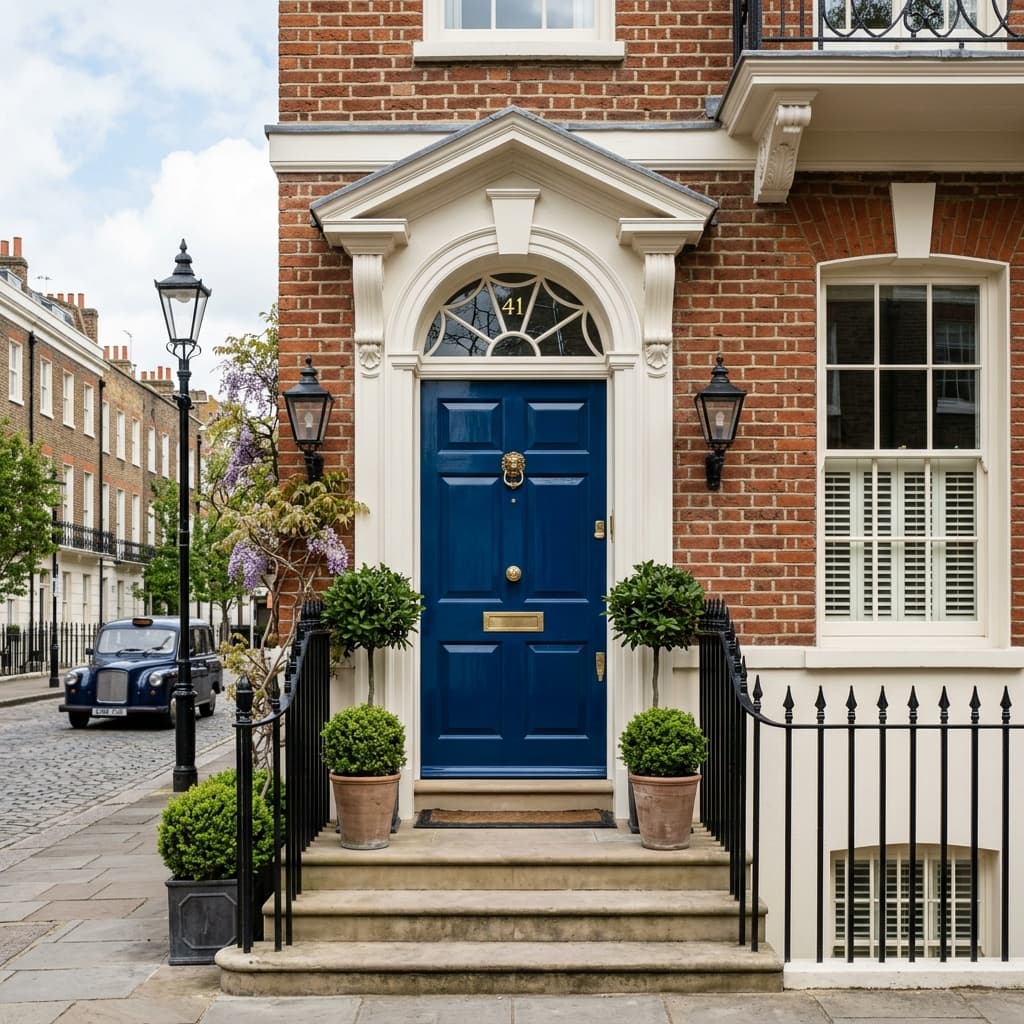
Old Church Street is one of Chelsea's oldest thoroughfares, and this Queen Anne townhouse, dating from approximately 1710, is among its most historically significant properties. The house retains an exceptional degree of original fabric — early eighteenth-century panelling in the principal rooms, original wide-board oak flooring, hand-made crown glass in several windows, and lime plaster walls and ceilings that have survived largely intact for over three centuries. The owner had received listed building consent for a programme of sensitive redecoration following structural repairs to the rear elevation, which had required temporary propping and the careful rebuilding of a section of original brickwork. The brief was clear and exacting: every aspect of the decoration must be reversible, historically appropriate, and executed using traditional methods and materials wherever possible. This meant limewash on original lime plaster walls, traditional linseed oil paint on all early joinery including the panelling, doors, window frames, and shutters, and casein distemper on the lath-and-plaster ceilings — techniques that modern painters rarely practise and that require specialised knowledge of materials that behave very differently from contemporary paints. Our heritage painting team, trained in traditional methods through courses at West Dean College and the Building Limes Forum, were ideally suited to this demanding brief. We worked under the close oversight of a heritage consultant appointed by the owner, who inspected each stage of the work before giving approval to proceed to the next phase. The programme covered all internal rooms across three floors, the original staircase with its turned balusters and moulded handrail, and the external front elevation including the original iron railings and entrance door.
The Challenge
Traditional paint systems behave very differently from modern products and demand specialised knowledge at every stage — knowledge that has been largely lost from mainstream decorating as the industry has shifted entirely to water-based and alkyd coatings. Limewash requires a damp substrate for proper adhesion and must be applied in multiple thin coats, each building opacity gradually as the lime carbonates and bonds with the plaster beneath — it cannot be rushed, and applying it too thickly or onto dry plaster causes flaking. Linseed oil paint, the only historically appropriate coating for pre-Victorian joinery, has extended drying times of three to five days between coats depending on temperature and humidity, and is sensitive to cold conditions that can prevent proper film formation. Casein distemper, the traditional ceiling coating, must be mixed fresh from powder on the morning of each application and worked quickly across the entire surface before it begins to set — any attempt to go back over a drying edge produces visible lap marks that cannot be corrected. Beyond the materials themselves, the property's original plaster surfaces were fragile and highly uneven, with repairs spanning three centuries creating a patchwork of different lime mixes, textures, and conditions. Modern preparation methods — power sanding, chemical strippers, synthetic fillers, PVA-based sealers — were all prohibited by the heritage consultant as inappropriate for the historic fabric. Every surface had to be prepared using hand tools, natural bristle brushes, lime-based fillers, and techniques that respected the building's age and significance. The work was further constrained by seasonal considerations — limewash and linseed oil paint perform best in spring and early autumn conditions, requiring us to plan the programme around the weather.
Our Approach
We assembled a specialist team of three painters experienced in heritage methods — all of whom had completed formal training in traditional decorating techniques — supplemented by a conservation plasterer from a firm recommended by the Society for the Protection of Ancient Buildings. All surfaces were cleaned using natural bristle brushes, warm water, and where necessary, gentle poultice cleaning — no chemicals, detergents, or mechanical methods were used at any stage. Loose and flaking material was carefully removed by hand using wooden scrapers that would not gouge the soft lime plaster beneath, and all plaster repairs used traditional lime putty mixed on-site from matured putty lime and sharp sand at a ratio specified by the heritage consultant. Limewash was applied in six thin coats to the principal rooms, each coat requiring 24 hours to carbonate before the next could be applied. The pigments — raw umber, yellow ochre, and terre verte — were sourced from a specialist heritage supplier and matched to shades identified in the conservation plan, which was itself informed by paint scrapes taken during the structural repair phase. Linseed oil paint, hand-made to a traditional recipe by Brouns & Co of Lewes using cold-pressed linseed oil and natural earth pigments, was applied to all original joinery — doors, window frames, shutters, panelling, the staircase handrail, and the turned balusters — with three coats applied over a two-week period to allow the extended drying time each coat required. Ceilings throughout received three coats of casein distemper mixed fresh from powder on the morning of each application, applied quickly with large, soft brushes in a single continuous pass across each ceiling. The exterior front elevation brickwork was cleaned with a gentle nebulous water spray over three days — a technique that softens dirt and pollution deposits without the pressure that would damage the soft Georgian brick — and repointed where necessary with lime mortar using St Astier NHL 3.5. The original wrought-iron railings were de-rusted by hand, primed with Owatrol Rustol CIP, and finished with a traditional linseed-based gloss from Brouns & Co.
The Result
The heritage consultant described the completed works as exemplary, noting that the limewash finish had achieved exactly the soft, luminous quality characteristic of authentic early eighteenth-century decoration — a quality that modern emulsion paints, however carefully applied, simply cannot replicate. The linseed oil paint on the joinery developed a beautiful depth and richness over the weeks following completion as it continued to oxidise and harden, the natural pigments gaining intensity with each passing day — a quality unique to traditional oil paint that no modern alkyd or water-based equivalent can match. The panelled rooms in particular took on a warmth and character that the owner described as the house finally looking as it was always meant to look. The property was subsequently opened for a Heritage Open Day organised by RBKC, where our work was presented as a case study in appropriate listed building decoration, attracting over 200 visitors. Historic England included the project in their updated guidance notes on traditional paint systems for listed buildings, and the heritage consultant has since recommended our team for three further heritage projects in the Royal Borough. The owner received a commendation from the Chelsea Society for the quality of the restoration.
Products Used
- ✓Brouns & Co traditional linseed oil paint (multiple heritage colours)
- ✓Rose of Jericho limewash with natural earth pigments
- ✓Casein distemper powder (mixed fresh on-site daily)
- ✓St Astier NHL 3.5 natural hydraulic lime for plaster repairs
- ✓Owatrol Rustol CIP primer for ironwork
- ✓Brouns & Co linseed oil-based exterior gloss for railings
- ✓Matured lime putty and sharp sand for plaster patching
- ✓Liberon fine-grade steel wool for gentle surface preparation
“Finding painters who genuinely understand traditional materials — limewash, linseed oil paint, casein distemper — is extraordinarily difficult. This team not only understood the materials but applied them with a skill and sensitivity that our heritage consultant described as the best he has seen in thirty years. The house feels alive in a way it never did under modern paints.”
Services Used in This Project
Interior Painting
Expert interior painting for Chelsea homes, from single rooms to complete redecorations.
Exterior Painting & Facade Work
Professional exterior painting and facade restoration for Chelsea properties.
Heritage & Listed Building Painting
Conservation-grade painting for Chelsea's listed and heritage properties.
Sash Window Painting & Restoration
Expert sash window painting and restoration for Chelsea period properties.
Eco-Friendly & Low-VOC Painting
Low-VOC and eco-friendly painting for healthier Chelsea homes.
Inspired by This Project?
We would love to discuss your property and how we can achieve similar results. Get a free, no-obligation quote from Chelsea's most trusted painting specialists.