Georgian Townhouse Restoration, Cheyne Walk
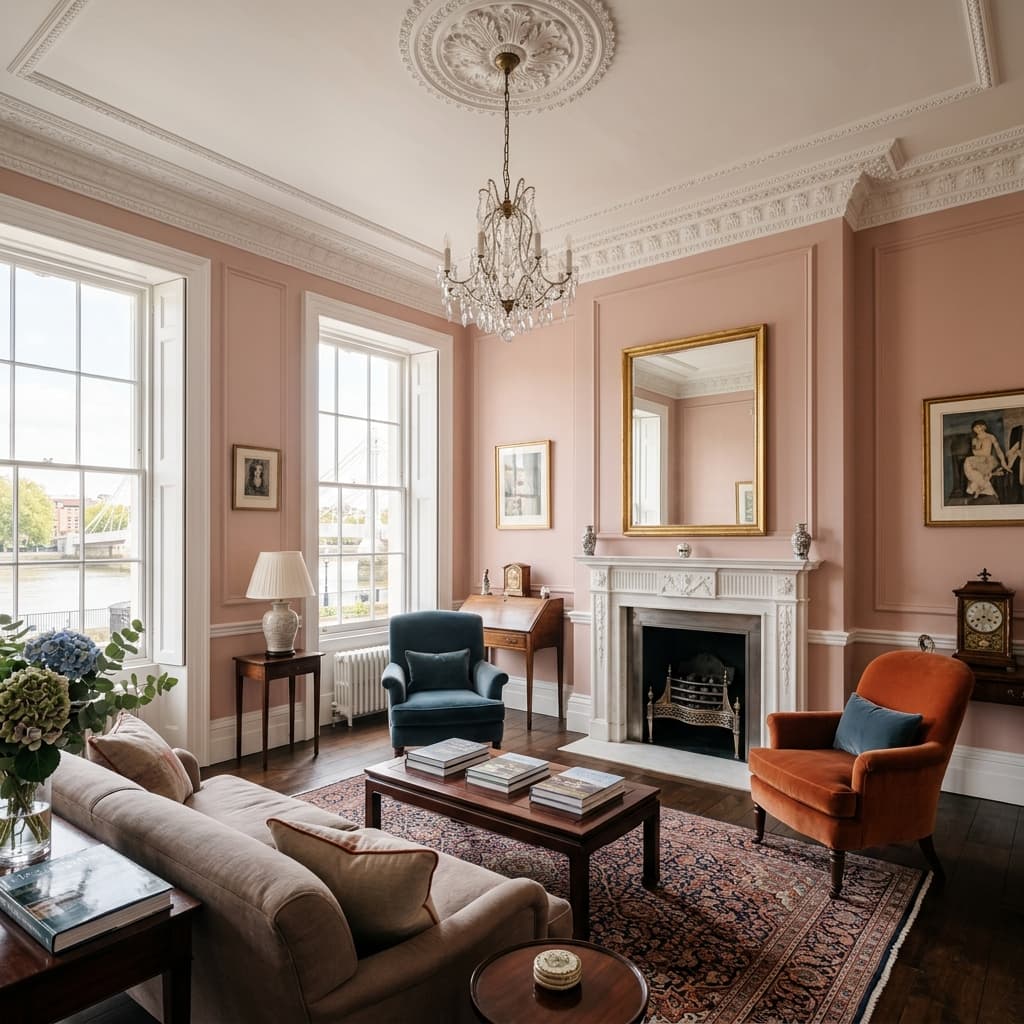
This five-storey Georgian townhouse on Cheyne Walk had not been fully redecorated since the early 1990s. The property, built in 1718 and listed at Grade II, required a comprehensive programme of interior and exterior restoration that respected its historic fabric while meeting the expectations of modern riverside living. Every room featured original panelling, hand-carved cornicing, and ceiling roses that demanded meticulous hand-finishing by our most experienced decorators. The exterior stucco was suffering from widespread cracking and paint failure, particularly on the Thames-facing southern elevation where decades of moisture exposure and salt-laden winds from the river had taken their toll on both the render and the decorative mouldings above the first-floor balcony. We worked closely with the owner's conservation architect and RBKC's planning department to agree a specification that honoured the building's heritage status while delivering a result that felt fresh, elegant, and thoroughly contemporary in its colour palette. The interior programme encompassed fourteen rooms across five floors, from the river-facing drawing room with its original Georgian shutters and panelled window reveals to the top-floor bedrooms with their sloping ceilings and dormer windows. The basement kitchen, converted in the 1980s, required a complete repaint using moisture-resistant systems suited to its below-ground environment. Particular care was taken in the principal first-floor reception rooms, where the original ceiling roses and dentil cornicing represented some of the finest surviving Georgian plasterwork on Cheyne Walk. Our team of six painters worked on the project full-time for the entire eight-week programme, with additional specialist support for the lead paint removal and exterior masonry phases.
The Challenge
The principal challenge was working within the strict constraints of a Grade II listing while delivering a finish that felt genuinely renewed. Multiple layers of historic paint — including lead-based coatings from the 1950s and earlier oil-bound distemper beneath — needed careful removal without damaging the original lime plasterwork beneath. In several rooms, we discovered up to fourteen distinct paint layers, the earliest dating to the mid-eighteenth century according to our paint archaeologist's analysis. The Thames-facing southern facade presented particular difficulties: persistent damp driven by prevailing south-westerly winds had caused widespread adhesion failure in the acrylic masonry paint applied by a previous contractor in the 1990s, and the ornate cast-iron balconies on the first and second floors required specialist metalwork treatment including rust stabilisation and priming before any decorative finish could be applied. Access to the front elevation was complicated by the Embankment's traffic management restrictions and proximity to the river wall — scaffolding could only be erected during weekend closures coordinated with RBKC highways, adding significant logistical complexity to the programme. Internally, the original lime plaster throughout the property was in variable condition, with several areas of delamination behind the existing paint layers that were not apparent until preparation began. The staircase, a continuous run from basement to attic with a delicate wrought-iron balustrade, required careful access planning using a bespoke scaffold tower system to reach the full height without loading the fragile treads excessively.
Our Approach
We began with a full paint archaeology survey, taking core samples from each room to understand the layered history of the property's decoration. This informed both our preparation methods and our colour recommendations, several of which drew on original Georgian pigments identified in the samples. Lead paint was removed using Peelaway chemical poultice stripping rather than heat guns or aggressive mechanical sanding, preserving the delicate plaster profiles beneath — a process that added three days to the programme but ensured zero damage to the original mouldings. Where lime plaster had delaminated, our conservation plasterer reattached loose sections using stainless steel screws and lime grout injection, a reversible technique approved by the conservation architect. All interior woodwork — including thirty-two panelled shutters, twelve six-panel doors, and the full staircase balustrade and handrail — was hand-prepared using wet-and-dry paper and flexible sanding blocks that followed the moulding profiles, then primed with Zinsser Cover Stain to seal residual staining before receiving three coats of Farrow & Ball Estate Eggshell in shades from their Traditional Colour range. The colour palette was developed in consultation with the conservation architect: Farrow & Ball String for the hallway, Off-White for the principal reception rooms, and Hague Blue for the study, each chosen for its historical sympathy with the Georgian period. The exterior received a breathable lime-based masonry paint system from Keim — their Granital mineral silicate product was chosen for its chemical bond with the original lime render and its proven longevity in exposed riverside conditions. All ironwork was prepared with Owatrol ESP adhesion primer before finishing with two coats of traditional gloss. Scaffolding was erected during a pre-agreed weekend window to minimise disruption to the Embankment, and all works were photographed and documented for the listed building record as required by the conservation officer.
The Result
The completed restoration brought the townhouse back to its Georgian best while providing the durability expected of a modern paint system. The owner commented that the property felt lighter, more spacious, and more coherent than it had in decades — they were particularly moved by the drawing room, where the restored ceiling rose and freshly painted panelling created a sense of elegance they had not experienced since purchasing the property twenty years earlier. RBKC's conservation officer praised the sensitive colour choices and the quality of preparation on the exterior stucco, noting that the Keim mineral finish achieved an authentically soft, matt appearance that complemented the Georgian character far better than the previous synthetic coating. The project has since been featured in Period Living magazine as an example of best-practice listed building decoration, and the paint archaeology report we commissioned has been deposited with the Chelsea local history archive. Three neighbouring properties on Cheyne Walk subsequently contacted us to carry out similar restoration programmes on their facades, citing the quality of our work as their primary motivation.
Products Used
- ✓Farrow & Ball Estate Eggshell (interior woodwork)
- ✓Farrow & Ball Estate Emulsion (interior walls)
- ✓Keim Granital mineral silicate masonry paint (exterior)
- ✓Keim Fixativ primer for mineral substrates
- ✓Zinsser Cover Stain oil-based primer for stain blocking
- ✓Owatrol ESP adhesion primer for exterior metalwork
- ✓Peelaway 1 chemical paint stripper for lead removal
- ✓St Astier NHL 3.5 natural hydraulic lime for plaster repairs
“They treated our home as though it were their own — every cornice, every sash, every panel was prepared and painted to an extraordinary standard. The house has not looked this good in living memory.”
Services Used in This Project
Interior Painting
Expert interior painting for Chelsea homes, from single rooms to complete redecorations.
Exterior Painting & Facade Work
Professional exterior painting and facade restoration for Chelsea properties.
Heritage & Listed Building Painting
Conservation-grade painting for Chelsea's listed and heritage properties.
Woodwork, Skirting & Trim Painting
Specialist woodwork finishing for Chelsea's period properties.
Sash Window Painting & Restoration
Expert sash window painting and restoration for Chelsea period properties.
Inspired by This Project?
We would love to discuss your property and how we can achieve similar results. Get a free, no-obligation quote from Chelsea's most trusted painting specialists.