Period Terrace Full Redecoration, Carlyle Square
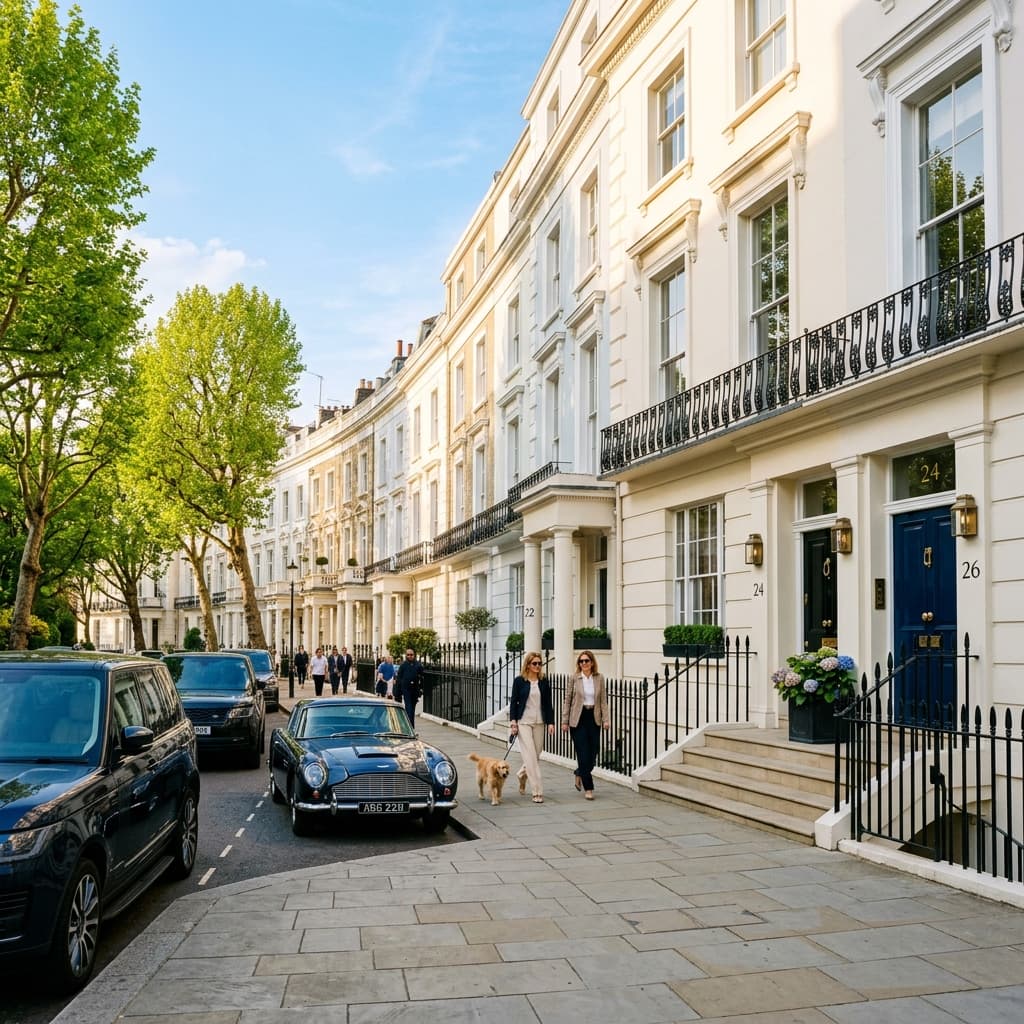
This handsome four-storey mid-terrace on Carlyle Square had been in the same family for over thirty years and was due a comprehensive interior redecoration — the last full repaint had been carried out in the mid-1990s, and while the property had been well maintained with occasional touch-ups, the accumulated wear across three decades of family life was evident throughout. The owners wanted to honour the Victorian character of the property while introducing a lighter, more contemporary palette suited to how they now use their home — the children having grown and left, the couple wanted rooms that felt calm, spacious, and filled with light rather than the warmer, darker scheme that had served them well during the family years. The brief was to repaint every room, hallway, and staircase from basement kitchen to attic bedroom — a total of fourteen rooms plus all circulation spaces, encompassing approximately 620 square metres of wall area, 180 square metres of ceiling, and over 300 linear metres of woodwork including skirting, architraves, picture rails, dado rails, doors, and the staircase from basement to attic. We worked with Farrow & Ball's in-house colour consultancy service to develop a scheme that flowed naturally through the house, with each room complementing its neighbours while maintaining its own distinct character — a process that involved three consultation visits and a full set of large-scale colour samples applied directly to the walls before final selections were confirmed. The project was completed while the family relocated to their country property in Hampshire for a month, allowing us uninterrupted access and the freedom to work efficiently across all four floors simultaneously with a team of five dedicated painters.
The Challenge
The property's Victorian plasterwork was in mixed condition after 150 years of life. Several ceilings showed hairline cracking consistent with age and structural settlement, with the first-floor drawing room ceiling exhibiting a network of fine cracks that needed stabilising before any paint would adhere successfully. The original cornicing in the two principal reception rooms — an elaborate acanthus-leaf design running to approximately 200mm depth — had been damaged by previous electrical work, with sections cut away and poorly patched with filler that had since cracked and separated. The basement kitchen had persistent condensation staining on the ceiling and upper walls, caused by years of cooking steam in a room with limited extraction, and the underlying plaster showed signs of salting that would bleed through any standard paint system. The attic rooms on the fourth floor showed evidence of historic minor water ingress at the eaves, with tide marks on the plaster and localised areas of soft, crumbly finish that needed cutting out and replastering. The staircase — a continuous run from basement to attic spanning the full height of the house, with a half-landing skylight at third-floor level — required careful access planning using a stairwell scaffold tower system to reach all surfaces safely. The owners also specifically requested that all original Victorian shutters, of which there were twenty-eight individual panels across the ground and first floors, be fully stripped back to bare timber and refinished rather than simply overcoated — a labour-intensive but ultimately far superior approach that would restore the crisp moulding profiles lost under decades of accumulated paint.
Our Approach
We began with a full week of intensive preparation across the entire house, working systematically from the top floor down. All ceilings were assessed and stabilised — hairline cracks were opened out with a scraper, filled with Toupret TX 110 flexible filler, and reinforced with self-adhesive scrim tape before being skimmed smooth by our plasterer to create a seamless base for painting. The damaged acanthus-leaf cornicing in the reception rooms was repaired by our specialist fibrous plasterer, who took silicone moulds from intact sections and cast replacement pieces that were fixed in situ with plaster adhesive and blended imperceptibly with the original. Condensation staining in the basement kitchen was treated with two coats of Zinsser BIN shellac-based primer — the only product that reliably blocks persistent nicotine and condensation staining — before decoration with a kitchen-grade emulsion. The twenty-eight shutter panels were carefully removed from their frames, labelled for position, transported to our workshop in Wandsworth, chemically stripped using Peelaway 7 to remove multiple paint layers back to clean timber, hand-sanded through grades from 80-grit to 240-grit, primed with Zinsser BIN, and finished with two coats of Farrow & Ball Estate Eggshell in Wimborne White before being returned and rehung in their original positions. All other woodwork throughout the house was prepared in situ — washed with sugar soap, sanded with 180-grit, filled where necessary with Toupret wood filler, spot-primed, and finished with two coats of Farrow & Ball Estate Eggshell. Walls received Farrow & Ball Estate Emulsion throughout, with the colour palette ranging from Strong White in the hallways to Hague Blue in the study, Sulking Room Pink in the principal bedroom, School House White in the attic rooms, and Pointing in the basement kitchen. The staircase was accessed using a combination of stair scaffolding and adjustable ladder platforms, allowing safe and stable working at every height from basement to the skylight at third-floor level.
The Result
The family returned from Hampshire to a home that felt entirely refreshed while retaining every element of its Victorian character. The restored acanthus-leaf cornicing, refinished shutters with their crisp moulding profiles revealed once more, and carefully considered Farrow & Ball colour scheme gave each room a coherent identity within a harmonious whole. The owners were particularly delighted with the shutters, which they described as looking better than they had in forty years — the difference between a stripped-and-refinished panel and one simply overcoated was, they said, immediately obvious and well worth the additional investment. The Hague Blue study became the husband's favourite room in the house, while the Sulking Room Pink bedroom was described by the wife as exactly the calm, sophisticated retreat she had envisioned. We provided a detailed room-by-room record of every Farrow & Ball colour used, including finish type and number of coats, along with labelled touch-up pots for each shade, a maintenance guide, and recommendations for cleaning and ongoing care of the painted surfaces. The family has since recommended us to three neighbours on Carlyle Square.
Products Used
- ✓Farrow & Ball Estate Emulsion (walls — multiple colours)
- ✓Farrow & Ball Estate Eggshell (all woodwork and shutters)
- ✓Zinsser BIN shellac primer for stain and knot blocking
- ✓Toupret TX 110 flexible filler for ceiling cracks
- ✓Toupret wood filler for joinery repairs
- ✓Peelaway 7 chemical paint stripper for shutter stripping
- ✓Gyproc EasiFill for general surface repairs
- ✓Hamilton Perfection brushes for cutting-in and period detail
“Coming home after a month away was genuinely emotional. They had transformed every room with such care and precision. The shutters, the cornicing, the colours — everything was perfect. It felt like a new house with all the character of the old one.”
Services Used in This Project
Interior Painting
Expert interior painting for Chelsea homes, from single rooms to complete redecorations.
Professional Decorating
Complete decorating services tailored to Chelsea's period properties and modern apartments.
Woodwork, Skirting & Trim Painting
Specialist woodwork finishing for Chelsea's period properties.
Ceiling Painting & Restoration
High ceiling painting and decorative plasterwork restoration for Chelsea properties.
Farrow & Ball Painting Specialists
Approved Farrow & Ball applicators delivering flawless results in Chelsea homes.
Inspired by This Project?
We would love to discuss your property and how we can achieve similar results. Get a free, no-obligation quote from Chelsea's most trusted painting specialists.